
The Relationship Between Margin and Leverage
What’s the Relationship Between Margin and Leverage?
Margin and leverage are closely connected. In fact, you use margin to access leverage.
Leverage gives you increased trading power, allowing you to control positions that are larger than the actual funds in your account. It’s a tool that amplifies both potential profits and potential losses.
Leverage is always expressed as a ratio, usually in the format “X:1”.
How Leverage Works
The leverage ratio shows the relationship between:
- The capital you have (your margin), and
- The total value of the position you can trade.
For example:
- Trading 1 standard lot of USD/JPY (100,000 units) without leverage requires $100,000 in your account.
- But with a 1% Margin Requirement, you only need $1,000 in your account.
- That means your leverage is 100:1.
Margin Requirement and Leverage Ratios
Here’s how leverage varies based on the margin requirement:
| Currency Pair | Margin Requirement | Leverage Ratio |
|---|---|---|
| EUR/USD | 2% | 50:1 |
| GBP/USD | 5% | 20:1 |
| USD/JPY | 4% | 25:1 |
| EUR/AUD | 3% | 33:1 |
Calculating Leverage and Margin
You can easily calculate one from the other:
- Leverage = 1 ÷ Margin Requirement
Example: 1 ÷ 0.02 (2%) = 50:1 - Margin Requirement = 1 ÷ Leverage
Example: 1 ÷ 100 = 0.01 or 1%
This shows that leverage and margin are inversely related:
Higher leverage means a lower margin requirement, and vice versa.
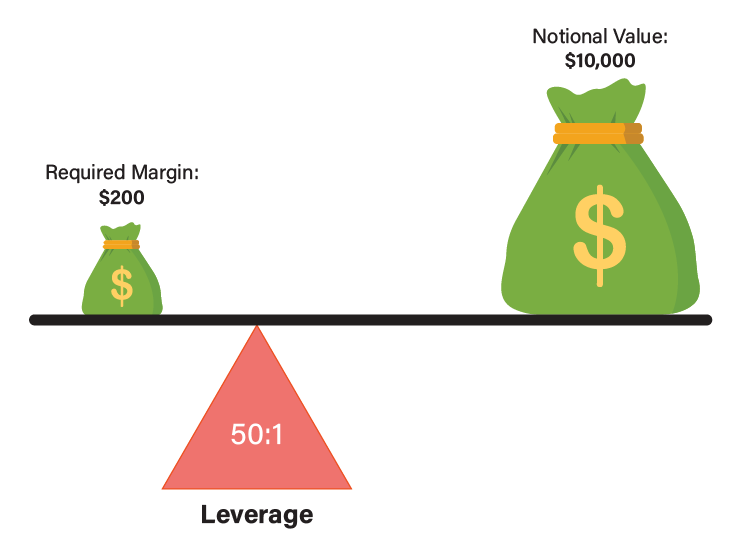
Leverage and Required Margin in Practice
When you open a trade, you’re required to commit a portion of the position’s value as collateral. This portion is called the Required Margin.
Example:
- Position size: $100,000
- Margin Requirement: 2%
- Required Margin: $100,000 × 0.02 = $2,000
- Leverage: 1 ÷ 0.02 = 50:1
You’re controlling a $100,000 position with just $2,000. That’s the power of leverage.
Margin in Forex vs. Margin in Stocks
It’s important to understand that forex margin is not the same as securities margin:
In Stock Trading:
- “Buying on margin” means borrowing money from your broker to buy assets.
- Typically, you pay a portion (like 50%) and borrow the rest.
- You own the asset and repay the loan over time.
In Forex Trading:
- Margin is not borrowed money.
- It’s a good faith deposit held by your broker to open and maintain positions.
- You do not own the currency pair.
- No actual borrowing occurs because you’re trading contracts, not physical assets.
So, while the term “margin” is used in both markets, it means very different things. Understanding this difference is critical before diving into forex trading.
Related Articles

What Does IFCCI Do? Advancing Financial Education, Certification and Research
7 Aug 2026
Understanding IFCCI: International Financial Consultant Certified Institute and Other Organizations Using the IFCCI Acronym
27 Jul 2026

Why International Financial Skills Championships Matter in Developing Global Financial Excellence
13 Jul 2026