
Take Profits on Gold but Stay Bullish, Says Tanglewood CIO
You can take some profits on gold and remain bullish, says Tanglewood’s Tom Bruce
Gold’s Resilience Amid Market Crosswinds
Global markets are navigating a complex environment of shifting monetary policy, resilient inflation, and safe-haven demand. Amid these dynamics, Tom Bruce, Chief Investment Officer of Tanglewood Wealth Management, has advised investors that it may be prudent to take partial profits on gold while still maintaining a structurally bullish outlook on the yellow metal.
His remarks come as spot gold hovers around the $2,420 per ounce level, consolidating after a powerful rally in Q2 2025 that saw prices touch record highs near $2,500.
Why Bruce Suggests Partial Profit-Taking
Bruce emphasized that risk management is as important as directional conviction.
“Markets rarely move in a straight line. Investors who entered gold positions during the earlier rally have captured significant gains. Trimming some exposure allows them to lock in profits without abandoning the long-term bullish thesis,” he explained.
He outlined three core reasons for short-term caution:
- Overbought Technicals – Relative Strength Index (RSI) readings suggest gold is temporarily overheated.
- Fed’s Data-Dependent Stance – A surprise shift in U.S. Federal Reserve rhetoric could cause short-term volatility.
- Capital Rotation – Investors may rebalance into equities as optimism about a soft landing strengthens.
Long-Term Drivers for Gold Remain Bullish
Despite advocating near-term prudence, Bruce reaffirmed his conviction that gold remains in a long-term uptrend. He highlighted several structural factors supporting a bullish thesis:
- Central Bank Buying – Net purchases from emerging market central banks have been the strongest in two decades.
- Geopolitical Hedging – Persistent global conflicts and U.S.-China tensions enhance gold’s safe-haven appeal.
- Monetary Debasement Risks – With U.S. national debt surpassing $36 trillion, concerns over long-term dollar stability underpin demand for real assets.
- Inflation Hedge – Even as CPI moderates, investors remain wary of sticky service-sector inflation.
Gold vs Other Asset Classes
Bruce compared gold’s risk-reward profile to equities, bonds, and cryptocurrencies:
- Equities: Attractive earnings outlook, but valuations remain stretched.
- Bonds: Yields have moderated, yet real returns may remain negative.
- Crypto: Rising institutional adoption, but volatility limits its defensive role.
“Gold remains a unique portfolio diversifier,” Bruce noted. “Unlike equities or digital assets, it is not a liability of another entity and thus provides stability in systemic risk scenarios.”
Tactical Strategy for Investors
Tanglewood suggests the following tactical allocation framework:
- Short-Term Investors (6–12 months): Consider trimming 10–20% of gold exposure to capture gains, while deploying capital into undervalued equity sectors.
- Long-Term Investors (3–5 years): Maintain core strategic allocations of 5–10% to gold, with flexibility to add on dips below $2,350.
- Institutional Portfolios: Continue allocating to gold as a hedge against unexpected Fed pivots and geopolitical escalations.
Implications for Asian and Emerging Market Investors
For investors in Asia—including Malaysia, Singapore, and Greater China—Bruce’s guidance holds particular weight. Gold remains a preferred wealth preservation tool in regions facing:
- Currency volatility against the U.S. dollar
- Rapidly changing interest rate cycles
- Rising household and corporate leverage
In Malaysia, where financial advisors certified by IFCCI increasingly incorporate precious metals into client portfolios, the case for balanced exposure to gold is becoming mainstream.
Expert Consensus: Trim, But Don’t Exit
Bruce’s view aligns with a growing consensus among wealth managers. Analysts from CFA Institute, World Gold Council, and UBS have all stressed that while tactical pullbacks are natural, the secular gold bull market remains intact.
This consensus suggests that institutional players and retail investors alike are better off treating gold corrections as opportunities rather than threats.
Conclusion
The message from Tanglewood’s Tom Bruce is clear: investors should not fear taking some chips off the table after a stellar rally. However, abandoning gold entirely would be premature given the macroeconomic uncertainties ahead.
For disciplined investors, the optimal strategy is to bank short-term profits while keeping long-term conviction intact. Gold remains a cornerstone of diversified portfolios—bridging wealth preservation, inflation protection, and geopolitical risk management.
Related Articles

What Does IFCCI Do? Advancing Financial Education, Certification and Research
7 Aug 2026
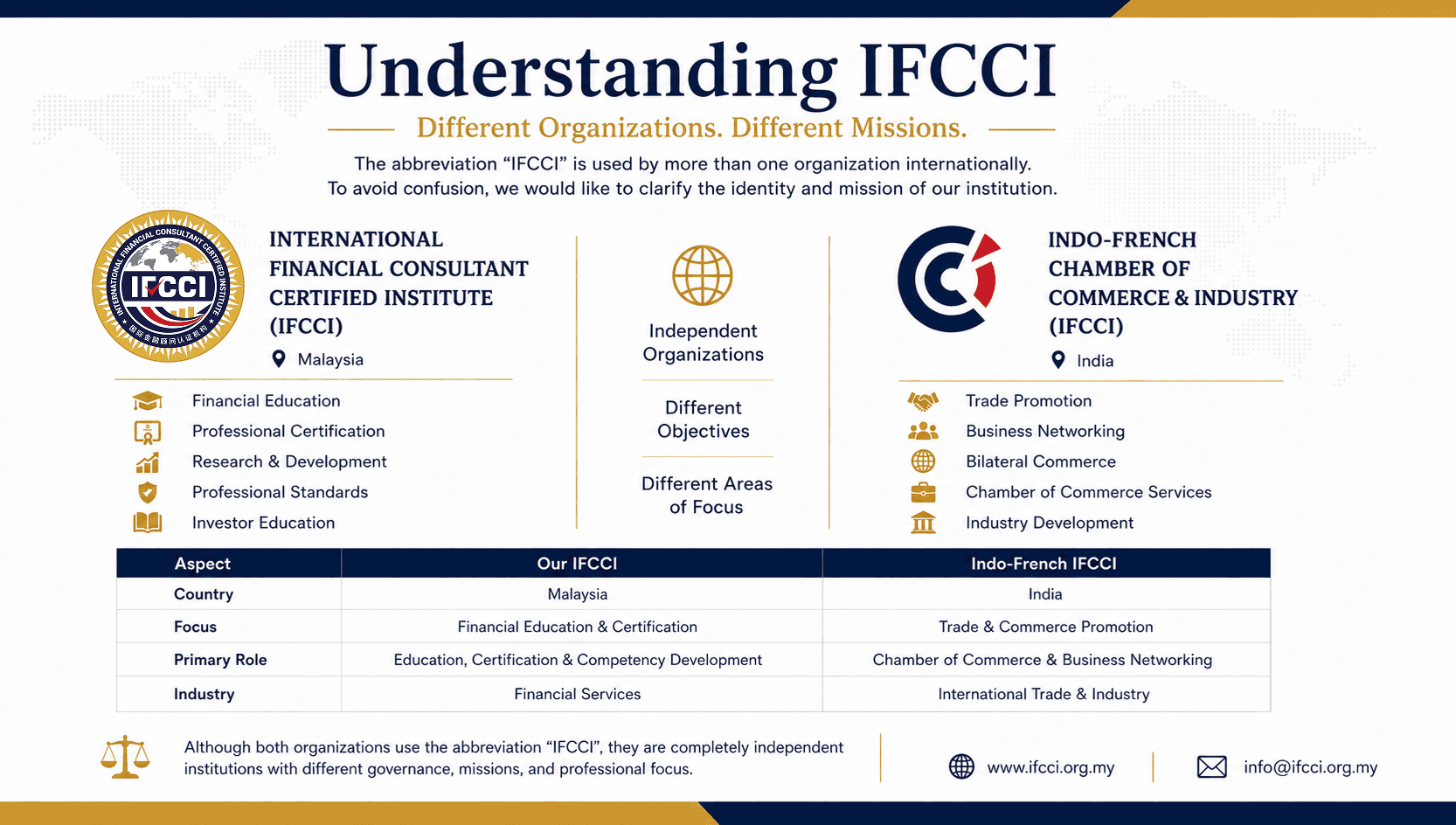
Understanding IFCCI: International Financial Consultant Certified Institute and Other Organizations Using the IFCCI Acronym
27 Jul 2026

Why International Financial Skills Championships Matter in Developing Global Financial Excellence
13 Jul 2026