
Mastering Forex Lingo: The Language of Currency Trading
Just like learning any new skill—or impressing someone you care about—you’ve got to learn the lingo first.
As a forex beginner, knowing key trading terms inside and out is essential before placing your first trade. Some of these might already be familiar, but a quick review never hurts.

Major, Minor & Exotic Currencies
Major currencies are the most frequently traded in the world, typically from countries with large, stable economies. These include USD, EUR, JPY, GBP, CHF, CAD, NZD, and AUD—also known as the “majors.” They’re highly liquid and widely accepted in the forex market.
Minor currencies come from smaller or developing economies. While still traded in meaningful volumes, they tend to be less liquid and more volatile than majors.
Exotic currencies are from less developed or emerging market economies. They are thinly traded, highly volatile, and often come with higher spreads and greater risk.
Base and Quote Currency
Base Currency
This is the first currency in a currency pair. It represents how much of the second currency (quote currency) is needed to buy one unit of the base.
Example:
If USD/CHF = 1.6350, one U.S. dollar is worth 1.6350 Swiss francs.
The U.S. dollar is typically used as the base currency in most pairs, except for a few such as EUR, GBP, AUD, and NZD.
Quote Currency
This is the second currency in the pair. Also known as the “counter” or “pip” currency, it reflects the value of the base. Unrealized profits or losses are expressed in this currency.
What’s a Pip?
A pip (short for “percentage in point”) is the smallest unit of price movement in forex.
Most currency pairs are quoted to four decimal places, where one pip is 0.0001.
Example:
If EUR/USD moves from 1.2538 to 1.2539, it moved 1 pip.
For JPY pairs, 1 pip equals 0.01 due to fewer decimal places.
What’s a Pipette?
A pipette is a fractional pip—1/10th of a pip. Some brokers offer five decimal quotes instead of four for more precise pricing.
Example:
EUR/USD at 1.23456 to 1.23457 = 1 pipette of movement.
These finer movements help traders execute more accurate strategies.
Bid and Ask Prices
Bid Price
This is the price at which the market (or broker) is willing to buy a currency pair.
As a trader, this is the price you’ll sell the base currency at.
Example: In GBP/USD = 1.8812/15, the bid is 1.8812.
Ask (Offer) Price
This is the price the market is willing to sell the currency pair at.
As a trader, you’ll buy the base currency at this price.
In EUR/USD = 1.2812/15, the ask price is 1.2815.
The Bid-Ask Spread
The spread is the difference between the bid and ask price.
This acts as the broker’s profit and your transaction cost.
Dealer’s shorthand often drops the first few digits. For instance:
USD/JPY quoted at 118.30/118.34 may be spoken as “30/34” — a 4-pip spread.
Quote Convention
Forex quotes are formatted as:
Base Currency / Quote Currency = Bid / Ask
Example: EUR/USD = 1.2345 / 1.2347
- Base: EUR
- Quote: USD
- Bid: 1.2345
- Ask: 1.2347
- Spread: 2 pips
Transaction Costs
The bid/ask spread also represents your transaction cost for a full trade cycle (buy + sell).
Example:
EUR/USD = 1.2812/15 → Spread = 3 pips
Formula:
Transaction Cost = Ask Price – Bid Price
Cross Currency Pairs
A cross currency pair includes two currencies that do not involve USD.
These pairs can be more volatile and come with higher transaction costs.
Example:
Going long on EUR/GBP is effectively buying EUR/USD and selling GBP/USD simultaneously.
Margin Explained
To trade forex, you must open a margin account with a broker and deposit a minimum balance. This requirement varies by broker—anywhere from $100 to $100,000.
When you open a trade, a percentage of your balance is set aside as initial margin, depending on the currency pair, lot size, and price.
Example:
- Account type: Mini
- Lot size: $10,000
- Leverage: 200:1 (0.5% margin)
You only need to deposit $50 to control $10,000 in currency.
Leverage
Leverage allows you to control large positions with a small deposit. It’s expressed as a ratio, like 50:1 or 200:1.
A 100:1 leverage means you can control $100,000 with just $1,000.
However, higher leverage increases both potential profits and potential losses. Use it wisely.
Now that you’ve mastered the forex vocabulary, you’re one step closer to navigating the market—and maybe even impressing someone with your financial fluency.
Ready to explore the types of trade orders next?
Related Articles

What Does IFCCI Do? Advancing Financial Education, Certification and Research
7 Aug 2026
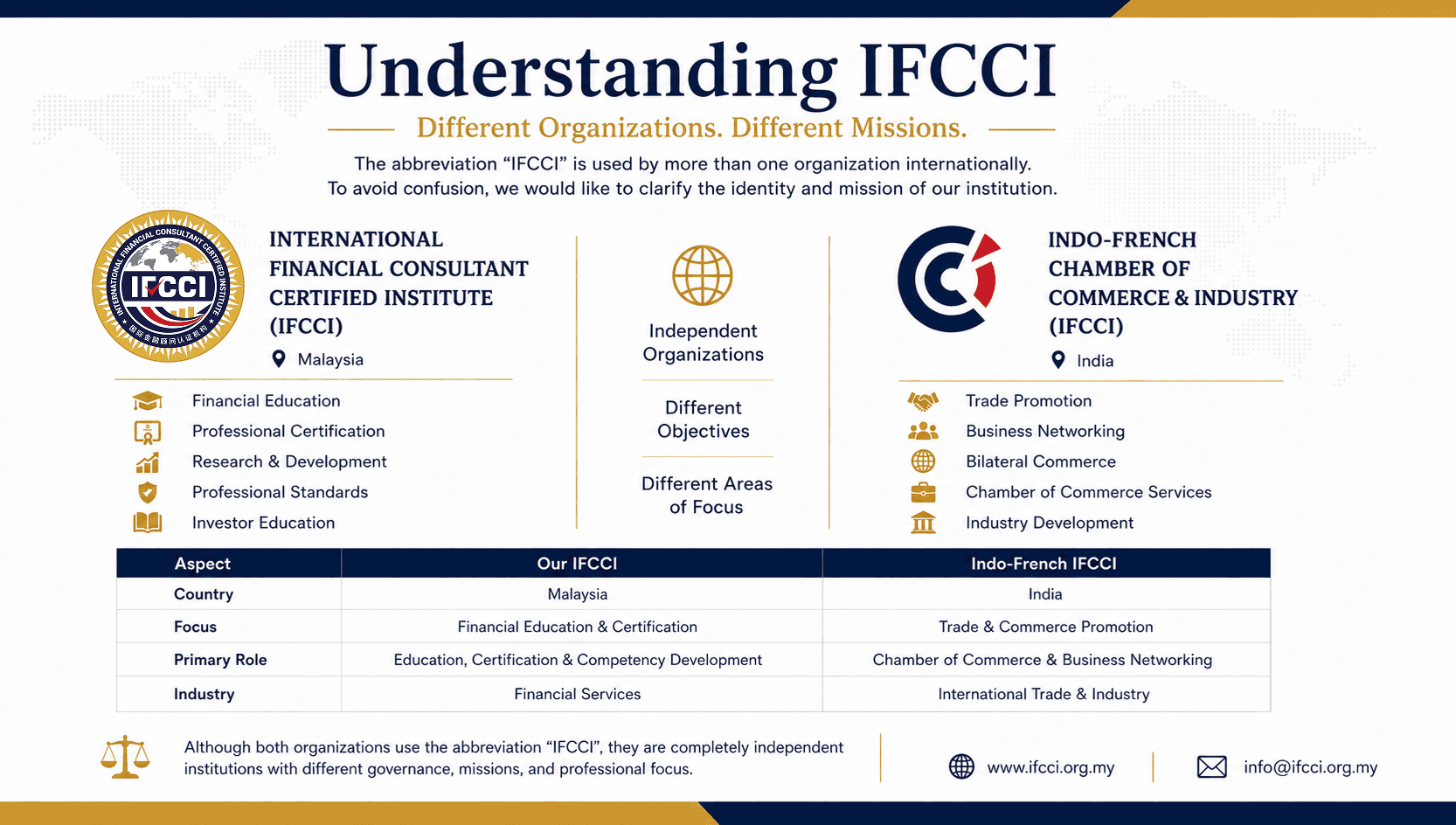
Understanding IFCCI: International Financial Consultant Certified Institute and Other Organizations Using the IFCCI Acronym
27 Jul 2026
Why International Financial Skills Championships Matter in Developing Global Financial Excellence
13 Jul 2026