
Bitcoin and Gold Move as Trump–Powell Tensions
Executive Summary
Bitcoin and gold have shown heightened sensitivity amid escalating tensions between former President Donald Trump and Federal Reserve Chair Jerome Powell, as markets reassess the balance between political influence and central bank independence in the United States.
The public friction has injected fresh uncertainty into monetary policy expectations, prompting investors to rotate toward assets traditionally perceived as hedges against institutional credibility risk, inflation uncertainty, and policy volatility.
Trump–Powell Rift Re-enters Market Focus
Recent remarks from Donald Trump, renewing criticism of the Federal Reserve’s policy stance and leadership, have revived concerns over potential political pressure on US monetary decision-making.
Although no formal policy changes have occurred, markets are increasingly attentive to:
- The tone and frequency of political commentary on Fed policy
- Implications for perceived Federal Reserve independence
- Risks of future leadership or mandate-related shifts
Even rhetorical escalation can influence expectations when credibility is central to policy effectiveness.
Gold Responds as a Classic Institutional Hedge
Gold prices have demonstrated relative resilience amid the renewed political-monetary tension.
Historically, gold benefits from:
- Concerns over central bank independence
- Rising political uncertainty
- Perceived erosion of fiat credibility
Market participants appear to be positioning defensively, viewing gold as a hedge against tail risks rather than an immediate inflation shock.
Bitcoin’s Reaction Reflects a Different Hedge Narrative
Bitcoin’s response has been more nuanced, reflecting its dual identity as both:
- A risk-sensitive digital asset
- A long-term hedge against monetary and political instability
The asset has attracted renewed interest from investors who view political interference in monetary policy as structurally supportive for non-sovereign, supply-constrained alternatives.
However, Bitcoin’s volatility remains significantly higher than gold, limiting its appeal to more conservative allocators.
Markets Reprice Policy Credibility Risk
The Trump–Powell dynamic has highlighted a broader market theme: policy credibility risk, distinct from traditional inflation or growth concerns.
Investors are increasingly differentiating between:
- Short-term rate decisions
- Long-term trust in institutional frameworks
Assets perceived as independent of political control tend to benefit when credibility risk rises, even in the absence of immediate macro deterioration.
Why This Matters for Broader Markets
Persistent political challenges to central bank authority can:
- Increase long-term inflation risk premiums
- Raise volatility across currency and bond markets
- Strengthen demand for alternative stores of value
While US institutions remain robust, markets tend to price risk incrementally rather than wait for structural breaks.
IFCCI Assessment: Narrative Risk Is Driving Allocation Shifts
The IFCCI Research Division assesses that current market moves are driven less by imminent policy action and more by narrative risk surrounding monetary governance.
Key observations include:
- Gold continues to function as the primary institutional hedge
- Bitcoin attracts marginal inflows from politically sensitive capital
- Traditional risk assets remain vulnerable to headline-driven volatility
Unless rhetoric translates into concrete policy changes, reactions are likely to remain measured rather than disorderly.
Conclusion
The renewed conflict between Donald Trump and Jerome Powell has reintroduced political risk into monetary policy discourse, prompting visible reactions in both gold and Bitcoin.
While neither asset is signalling systemic stress, their movements underscore a familiar market reality: when confidence in institutions is questioned, alternative stores of value regain relevance.
As the situation evolves, markets will continue to distinguish between political noise and structural policy shifts—adjusting allocations accordingly.
Related Articles

What Does IFCCI Do? Advancing Financial Education, Certification and Research
7 Aug 2026
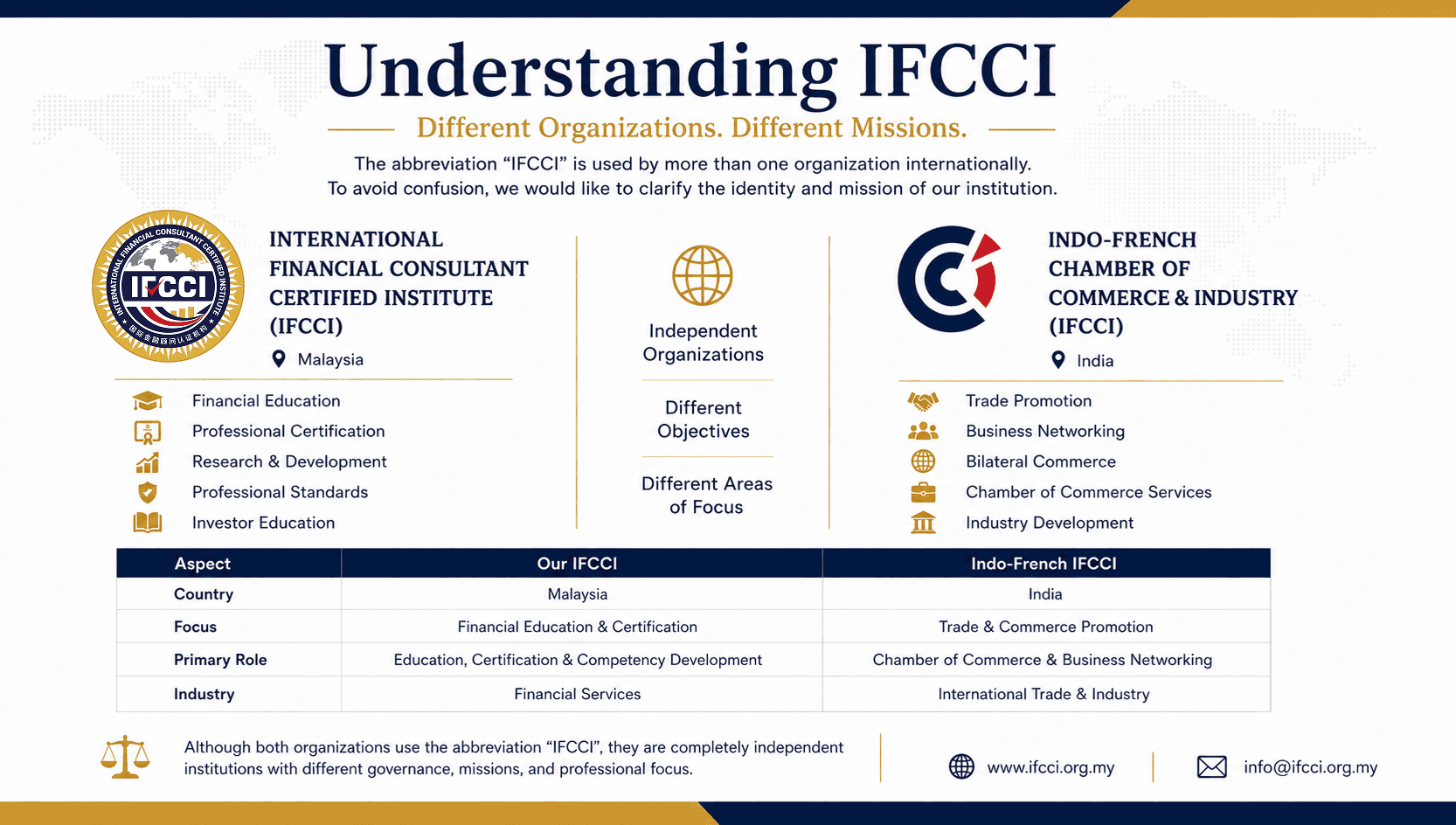
Understanding IFCCI: International Financial Consultant Certified Institute and Other Organizations Using the IFCCI Acronym
27 Jul 2026

Why International Financial Skills Championships Matter in Developing Global Financial Excellence
13 Jul 2026