Best Forex Trading in Malaysia: Regulatory Standards and Risk Frameworks

Introduction
Foreign exchange (forex) trading in Malaysia has evolved significantly in recent years, shaped by regulatory initiatives, institutional engagement, and increasing demand for professional-grade financial education. As part of the broader Asian financial landscape, Malaysia plays a strategic role in facilitating regional forex activity, driven by both retail participation and institutional flows. This article examines the core components of the best forex trading practices in Malaysia, focusing on regulatory standards, risk frameworks, institutional education, and accreditation models essential for sustainable market development.
Understanding the Topic
Forex trading involves the exchange of currencies in a decentralized global market. In Malaysia, this activity is regulated under specific legal frameworks to ensure transparency, investor protection, and market integrity. Institutions operating in the Malaysian forex space must align with the guidelines issued by key regulatory authorities such as Bank Negara Malaysia (BNM) and the Securities Commission Malaysia (SC), particularly when catering to retail traders or offering educational services.
The concept of “best forex trading” from an institutional and policy perspective is not limited to profitable strategies. It encompasses regulatory compliance, access to reliable education, investment in technology infrastructure, adherence to risk management best practices, and alignment with regional and global standards.
Why This Matters in Asia
The significance of high-quality forex trading practices in Malaysia cannot be separated from the greater Asian financial ecosystem. Asia accounts for a large portion of global forex volume, with key trading hubs like Singapore, Hong Kong, and Tokyo leading regional benchmarks. Malaysia’s proximity to these centers, coupled with its growing fintech ecosystem and supportive regulatory stance, positions the country as a viable node for forex infrastructure and education-led growth.
Moreover, regional cooperation through bodies such as the ASEAN Capital Markets Forum (ACMF) emphasizes the harmonization of standards across member states, increasing the importance of cross-border regulatory compatibility and institutional robustness. In this context, Malaysia’s ability to support compliant, well-regulated forex activity has broader implications for market reliability and investor confidence throughout Asia.
Key Evaluation Criteria
- Regulatory Compliance: Entities involved in forex trading must comply with the licensing and operational guidelines set by domestic regulators such as BNM and SC. Unauthorized offshore brokers targeting Malaysian residents are deemed non-compliant.
- Educational Accreditation: Forex education providers should adhere to quality assurance mechanisms and, where possible, be registered with institutions such as the Malaysian Qualifications Agency (MQA).
- Market Transparency: Best practices include full disclosure of trading conditions, spreads, leverage policies, and risk procedures. Transparency is critical for both institutional and retail segments.
- Risk Management Frameworks: Firms and education providers must promote sound risk management protocols, including exposure limits, margin requirements, and scenario analysis.
- Institutional Support: Engaging with recognized finance institutions, legal professionals, and academic researchers enhances the credibility and stability of the forex sector.
- Technology Infrastructure: Reliable execution platforms, data protection compliance, and audit traceability are technical indicators of best practice forex operations.
Common Risks and Misconceptions
Despite growing awareness, several risks and misconceptions persist in Malaysia’s forex trading landscape. One of the primary risks relates to the use of unlicensed brokers who often promote high-leverage instruments to retail traders without adequate disclosure or risk warnings. Engaging with such entities can lead to legal, financial, and cybersecurity vulnerabilities.
An additional misconception is the belief that forex trading guarantees consistent profits. This narrative, often marketed through social media channels, undermines the complex nature of financial markets and the role of disciplined strategy and compliance. Risk is inherent in all market activity, and without regulated oversight, educational safeguards, and professional guidance, retail traders remain exposed to significant financial loss.
Another concern is insufficient knowledge about capital adequacy regimes and anti-money laundering (AML) obligations applicable to trading platforms operating in Malaysia. Institutions and retail participants must recognize the rigidity of these requirements and the consequences of non-compliance.
Standards, Certification, and Institutional Frameworks
The pursuit of best forex trading practices in Malaysia is underpinned by a range of domestic and international frameworks. Regulators such as BNM oversee the authorisation of financial institutions, while the SC enforces conduct standards and market transparency. For entities offering forex education, alignment with the MQA ensures that training programs meet defined pedagogical and content quality benchmarks.
Institutions such as the Asian Institute of Finance and the Financial Accreditation Agency (FAA) contribute to the development of professional certifications tailored to capital market activities, including currencies. Globally recognized credentials—such as the Chartered Financial Analyst (CFA) and Certified Financial Technician (CFTe)—are increasingly incorporated into local education strategies to enhance capability and enforce standardization.
From a compliance standpoint, international protocols such as the Basel III framework and Financial Action Task Force (FATF) recommendations guide capital and risk requirements. Local application of these standards by financial service providers further legitimizes Malaysia’s forex market within the regional financial architecture.
Institutional partnerships, including university programs with fintech applications and central bank research initiatives, play a constructive role in training talent, disseminating research, and promoting informed participation. These initiatives support a long-term vision of forex trading that is safe, transparent, and driven by evidence-based policy design.
Conclusion
The best forex trading practices in Malaysia are defined by a blend of regulatory oversight, educational structure, risk governance, and institutional maturity. As part of the wider Asian financial network, Malaysia’s ability to promote compliant and informed forex trading has regional implications related to investor protection, capital mobility, and financial market development.
Key stakeholders—including educators, regulators, and trading platforms—share a collective responsibility to uphold standards and minimize systemic risk. As market complexity increases, so too must the rigor of oversight and the quality of information available to participants. By centering institutional frameworks and regulatory alignment, Malaysia can continue to develop a credible, secure, and inclusive forex trading environment in Asia.
Disclaimer
This article is for educational and informational purposes only and does not constitute investment or trading advice.
Related Articles

What Does IFCCI Do? Advancing Financial Education, Certification and Research
7 Aug 2026
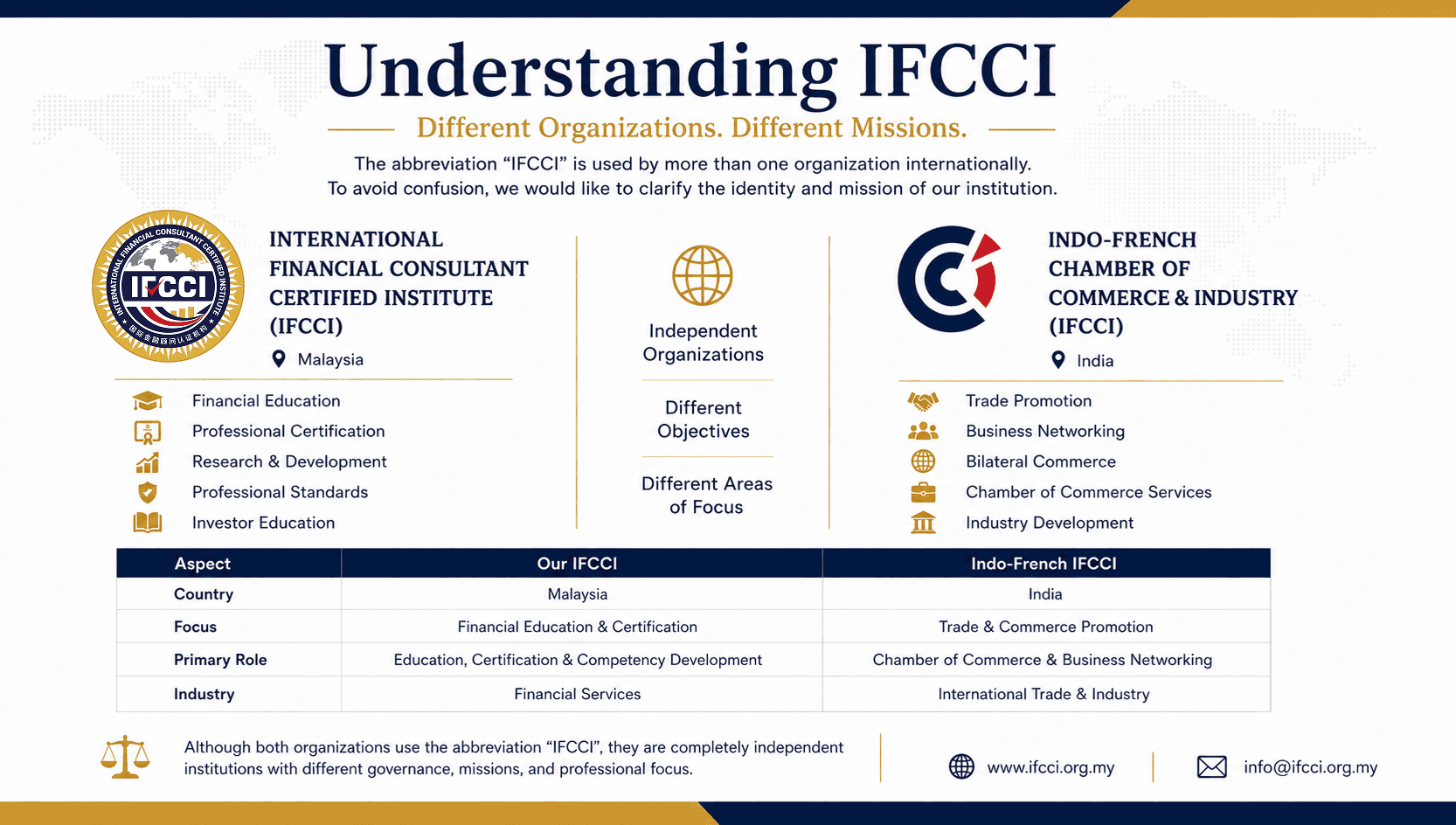
Understanding IFCCI: International Financial Consultant Certified Institute and Other Organizations Using the IFCCI Acronym
27 Jul 2026
Why International Financial Skills Championships Matter in Developing Global Financial Excellence
13 Jul 2026