What Does IFCCI Do? Advancing Financial Education, Certification and Research
What Does IFCCI Do?
The International Financial Consultant Certified Institute (IFCCI) is a Malaysia-based, independent non-profit professional institute that advances financial education, professional competency, certification, research, and public awareness. Its purpose is not to provide investment advice, trading signals, brokerage services, or promises of financial returns. Instead, IFCCI works to build the professional infrastructure that helps people identify credible knowledge, demonstrate competence, understand risk, and engage with financial markets more responsibly.
Modern finance affects individuals, businesses, and communities every day. Yet the financial information people encounter is often uneven in quality. Educational content may be fragmented, professional titles may be difficult to interpret, and claims made online may be hard for the public to assess. In this environment, competence, ethics, transparent communication, and independently governed standards matter. IFCCI addresses these needs through connected work in education, certification, research, transparency, and investor awareness.
In practical terms, IFCCI develops structured learning pathways, establishes competency-based assessment frameworks, supports research and market-integrity initiatives, promotes public financial literacy, and contributes to a stronger culture of professional responsibility. These functions serve aspiring practitioners, working professionals, educators, industry participants, and members of the public who need clearer ways to evaluate financial information and professional capability.
This article explains the institutional role of IFCCI, why its work matters, and how its core functions fit together.
Understanding IFCCI's Institutional Role
IFCCI is best understood as a professional standards institution. A standards institution does more than offer a course or issue a certificate. It helps define what meaningful competence looks like, how it can be assessed, how professional conduct should be approached, and how relevant knowledge can be communicated responsibly.
The International Financial Consultant Certified Institute operates from Malaysia with an Asia-serving outlook. Its work recognises that financial markets are increasingly interconnected, information moves quickly across borders, and financial professionals need both technical understanding and sound professional judgement. Education may introduce concepts; certification may assess demonstrated knowledge; research may examine real-world issues; and public-interest initiatives may help people understand risks. Together, these functions create a more complete framework than any one activity could provide alone.
IFCCI's institutional role is therefore broader than training delivery. It seeks to support a financial ecosystem in which competence can be developed systematically, professional credentials can be more transparent, and financial communication is treated as a responsibility rather than simply a marketing activity. This is especially important in environments where the public must distinguish educational information from advice, credible practitioners from unverified claims, and risk-aware decision-making from speculation.
The institute's work is guided by a public-interest orientation. It encourages financial knowledge that is structured, examinable, evidence-informed, and accessible. It also emphasises that a professional standard is not merely a label. It must be supported by learning expectations, fair assessment, governance, ethics, and the willingness to maintain competence over time.
Why Financial Professional Standards Matter
Financial decisions can have long-term consequences. They may involve personal savings, business cash flow, retirement planning, risk management, investment products, or complex market instruments. Because financial topics can be technical, people often rely on professionals, educators, platforms, or online content to help them understand what they are seeing. That reliance makes professional standards important.
Strong standards provide a shared reference point. They help clarify the knowledge, analytical ability, ethical awareness, and practical discipline expected of a professional role. They also make it easier for learners and the public to ask useful questions: What has this individual studied? What has been assessed? Is the credential verifiable? Does the communication acknowledge risk? Is a claim educational, promotional, or advisory?
IFCCI contributes to this standards-based approach by focusing on competence and responsible communication. The goal is not to suggest that one qualification guarantees professional success or investment outcomes. Rather, it is to encourage clearer pathways for learning, assessment, and continued development. A profession becomes more trustworthy when its participants can demonstrate relevant knowledge, recognise the limits of their expertise, and communicate with integrity.
This approach also supports industry development. Clearer competency expectations can assist employers, educators, and practitioners in discussing the skills that matter. Publicly verifiable credentials and transparent frameworks can improve confidence in professional claims. Research and awareness initiatives can bring attention to market practices that deserve scrutiny. These are practical building blocks for a more responsible financial environment.
Building Structured Financial Education
Building Structured Financial Education
Financial education is one of IFCCI's central functions. The institute supports structured learning designed to help people understand financial markets, market behaviour, analytical methods, risk, and the context in which financial decisions are made. Its educational work is intended to build knowledge progressively, rather than reducing complex subjects to isolated tips or short-term predictions.
Good financial education combines theory with application. Learners need concepts and definitions, but they also need to understand how those concepts relate to changing market conditions, incomplete information, uncertainty, and professional judgement. They should learn to ask how a conclusion was reached, which assumptions are involved, what risks remain, and where further verification may be necessary. That analytical habit is valuable across financial roles.
IFCCI's education pathway includes professional diploma programmes such as the Diploma in Financial Market Analysis (DFMA), as well as open educational resources. These initiatives are designed to make financial knowledge more structured and accessible while maintaining an emphasis on practical understanding. The purpose is not to turn education into a recommendation to buy, sell, or trade any particular product. Education should enable better questions and more informed judgement.
Structured learning is also important because financial knowledge changes. Market practices, technology, regulation, products, and public risks evolve. A one-time exposure to a topic is rarely enough. IFCCI therefore promotes a lifelong-learning mindset in which professionals and learners update their knowledge, revisit foundational principles, and remain attentive to developments that affect their field.
For individuals entering the industry, education can provide a disciplined starting point. For experienced practitioners, it can support professional renewal and broader perspective. For the public, accessible educational content can improve basic financial literacy and reduce reliance on unverified sources. Across these groups, the shared objective is stronger financial understanding—not a promise of financial performance.
Developing Competency-Based Certification
Certification is another core function of the International Financial Consultant Certified Institute. A meaningful certification framework should assess more than attendance. It should set expectations for knowledge, practical understanding, ethical awareness, and professional conduct, then evaluate candidates through a clear and appropriately governed process.
Competency-based certification matters because a professional title should communicate something useful. It should indicate that an individual has met defined assessment requirements, not merely completed promotional training. IFCCI's certification approach is built around transparent standards, examinations, assessment levels, and public verifiability. These elements help make competence more visible to employers, peers, and the public.
One example is the Certified Financial Trader (CFT) examination and certification pathway. The CFT is positioned as a professional certification for financial-market practitioners. Its focus is on relevant market knowledge, analytical thinking, risk awareness, professional discipline, and responsible practice. It should not be interpreted as a guarantee of investment ability, employment, income, or trading results. Certification confirms achievement against an assessment framework; it does not remove the uncertainty inherent in financial markets.
Fair certification governance is as important as the syllabus itself. Candidates should understand the requirements, assessment structure, and progression pathway. The public should be able to distinguish a verifiable credential from an unsupported claim. IFCCI supports this principle through certification information and verification resources, helping to create a clearer connection between a credential and the standards behind it.
Certification also reinforces accountability. When competence is made visible, professionals are encouraged to maintain standards in their work and communication. This does not mean a credential alone determines a person's integrity. It means that education, assessment, professional conduct, and ongoing development can be brought together in a framework that gives integrity a stronger institutional foundation.
Supporting Lifelong Professional Learning
Financial competence is not static. An individual may begin with a foundation in market analysis, gain practical experience, and later encounter new instruments, technologies, client expectations, risk considerations, or industry standards. Continuous learning is therefore central to professional development.
IFCCI supports a culture in which learning continues beyond the first programme or examination. This includes the need to refresh technical knowledge, reflect on professional responsibilities, learn from research, and keep pace with market developments. Lifelong learning is not simply an administrative requirement; it is an acknowledgement that financial work involves changing conditions and real consequences.
A continuing-development mindset can improve the quality of financial communication. Professionals who keep learning are better positioned to explain uncertainty, avoid overstating confidence, and recognise when a matter requires specialised expertise. They are also more likely to evaluate information critically rather than repeat popular narratives without context.
For the institute, supporting lifelong learning means creating a connected environment of diplomas, certifications, research, publications, and public educational resources. A learner can deepen knowledge over time, while a professional can draw on structured materials and professional standards as their responsibilities evolve. This helps place competence at the centre of career development instead of treating it as a one-time achievement.
Conducting Independent Research and Building Knowledge
Conducting Independent Research and Building Knowledge
Research is a vital part of IFCCI's mission because professional standards should be informed by evidence, observation, and careful analysis. Financial markets develop quickly, and assumptions that go unexamined can create risks for both professionals and the public. Independent research helps identify issues, test ideas, examine market practices, and support more informed discussion.
Through its research activities and publications, IFCCI contributes to areas such as market structure, professional standards, financial literacy, platform integrity, and responsible financial communication. Research may take the form of studies, reports, observations, frameworks, publications, or industry insights. Its value lies in helping readers move beyond unsupported claims toward a clearer understanding of evidence, limitations, and context.
An evidence-informed approach is especially important when financial information is widely shared online. A persuasive headline, a social-media post, or a confident personality is not a substitute for methodology. Research encourages people to ask what was measured, how a conclusion was reached, whether the source is independent, and what uncertainties or conflicts may be present.
IFCCI's research role also complements its education and certification functions. Research can inform learning content; emerging issues can guide professional-development priorities; and transparent standards can be improved when they are tested against real-world conditions. In this way, research is not separate from professional education. It is part of the process through which institutions keep their knowledge relevant and their standards responsive.
Promoting Transparency and Market Integrity
Transparency is essential to trust. In finance, people need clear information about who they are dealing with, what claims are being made, what risks may apply, and whether relevant credentials or platform information can be verified. Where information is incomplete, misleading, or difficult to check, poor decisions become more likely.
IFCCI supports transparency through structured assessment and public-information initiatives, including the IFCCI Platform Transparency Initiative (IPTI). The IPTI framework is intended to encourage clearer disclosure, accountability, and responsible market practices across relevant platforms, academies, and professionals. Its purpose is to make meaningful information easier to assess, not to endorse a product, guarantee a platform, or replace a user's own due diligence.
Market integrity is broader than identifying a single problem. It involves creating conditions in which claims can be evaluated, conduct can be discussed openly, and risks are not hidden behind promotional language. Transparency frameworks can help make visible such matters as public disclosures, verification processes, professional profiles, and complaint or risk information. Visibility does not eliminate all risk, but it gives people a better basis for asking questions and making careful decisions.
IFCCI's transparency work reflects a principle that accountability requires information. When professionals and organisations communicate openly about their status, methods, and limitations, the public can assess them more responsibly. When institutions publish standards and maintain verifiable processes, confidence can be based on evidence rather than assumption.
Strengthening Investor Education and Public Awareness
IFCCI serves not only professionals and learners but also the wider public. Investor education and public awareness are important because financial risks often reach people before they have the information needed to assess them. Misleading promotions, unrealistic return claims, impersonation, and complicated products can make it difficult for individuals to know where to begin.
Public financial education should give people useful foundations: how to recognise that all investing involves risk; why they should verify information; how to distinguish education from personal advice; why credentials and regulatory status matter; and when to seek assistance from an appropriately authorised professional. It should encourage caution without discouraging learning.
IFCCI supports this work through resources and initiatives such as its Investor Awareness Program, educational articles, awareness activities, and risk-focused information. These efforts aim to improve financial literacy and responsible decision-making. They are educational and informational in nature and do not constitute financial, investment, legal, or tax advice.
The public-interest value of this work is clear. A person with stronger financial awareness is better able to question an offer that appears too good to be true, check whether a claim can be verified, and understand that urgency is often a warning sign rather than a reason to act. Awareness initiatives can therefore contribute to prevention as well as education.
Responsible communication is central here. Public education should be plain enough to understand but careful enough not to oversimplify risk. It should avoid presenting markets as a shortcut to guaranteed wealth. Instead, it should promote curiosity, verification, thoughtful decision-making, and an appreciation of the limits of general information.
Encouraging Ethics and Responsible Financial Communication
Technical knowledge without ethics is not sufficient for a healthy financial ecosystem. Professionals and organisations influence how people understand risk, opportunity, and credibility. Their communication can help people make better-informed choices—or it can create false confidence. IFCCI therefore treats ethics, integrity, and responsibility as part of professional competence.
Responsible financial communication requires accuracy, appropriate context, and clear boundaries. It means identifying educational content as education, disclosing relevant limitations, avoiding unsupported promises, and not presenting general information as personalised advice. It also means recognising that an audience may interpret confident language as a recommendation, even when that was not the writer's intention.
IFCCI's standards-oriented work encourages professionals to communicate in ways that respect the public. This includes a focus on transparency, verifiability, and professional conduct. By linking ethical awareness with education, certification, research, and public awareness, the institute supports a more complete view of competence: a capable professional should know not only how markets work, but also how their words and actions affect others.
Supporting Malaysia's Financial Ecosystem and an Asia-Serving Future
IFCCI is rooted in Malaysia and works with an Asia-serving perspective. Malaysia's financial ecosystem includes diverse participants, from learners and educators to financial practitioners, technology providers, and members of the public. The region also experiences rapid innovation, cross-border information flows, and growing interest in a wide range of financial topics. These conditions make coherent professional standards increasingly valuable.
The institute contributes by building foundations that can support a more informed and accountable ecosystem: structured education, competency assessment, independent research, transparency infrastructure, and public awareness. This does not replace the work of regulators, licensed financial-service providers, universities, or employers. Each has a distinct role. IFCCI's contribution is to strengthen the standards, learning, and public-interest infrastructure that connects professional development with responsible financial practice.
An Asia-serving outlook also requires humility. Markets and regulatory settings differ by jurisdiction; professional needs vary by sector; and financial education must be adapted to local context. IFCCI's role is not to impose a one-size-fits-all answer, but to advance principles that travel well: competence should be demonstrable, credentials should be verifiable, research should be evidence-informed, and communication should be responsible.
How IFCCI's Core Functions Work Together
- Education helps learners develop foundational and applied knowledge.
- Certification provides a structured way to assess defined competencies.
- Continuous learning helps professionals keep knowledge current.
- Research examines issues, evidence, and market practices that inform standards.
- Transparency initiatives make relevant information more visible and assessable.
- Public awareness helps individuals recognise risk and evaluate information responsibly.
This integrated approach matters because financial professionalism cannot be reduced to a single exam, article, or awareness campaign. A professional may need education and assessment. A member of the public may need clear information and a way to verify claims. An institution may need research to improve its standards. By working across these areas, IFCCI seeks to support lasting improvements in knowledge, accountability, and trust.
Frequently Asked Questions
What does IFCCI do?
IFCCI advances financial education, professional competency development, certification, research, transparency, and investor awareness. It works as an independent, Malaysia-based professional institute with an Asia-serving outlook.
What does IFCCI stand for?
IFCCI stands for the International Financial Consultant Certified Institute. It is distinct from other organisations that may use the same acronym. For clarification, read Understanding IFCCI and Other Organisations Using the IFCCI Acronym.
Is IFCCI a university or a government agency?
No. IFCCI is an independent non-profit professional institute registered in Malaysia. It is not a university and is not a government agency.
Is IFCCI a financial-services provider, broker, or investment adviser?
No. IFCCI is not a broker and does not provide investment advice, trading signals, or guaranteed returns. Its website content and initiatives are educational and informational unless expressly stated otherwise.
What is the purpose of IFCCI certification?
IFCCI certification is intended to assess competence against defined professional standards. It can demonstrate that a candidate has met specified assessment requirements, but it does not guarantee employment, financial performance, or investment outcomes.
What are DFMA and CFT?
DFMA refers to the Diploma in Financial Market Analysis, a structured educational programme. CFT refers to Certified Financial Trader, an IFCCI professional certification pathway for financial-market practitioners. Each has its own published learning or assessment requirements.
What is IPTI?
IPTI is the IFCCI Platform Transparency Initiative. It is a transparency-oriented framework designed to encourage clearer information, responsible disclosure, and accountability. It is not a substitute for independent due diligence or regulatory verification.
How does IFCCI support public protection?
IFCCI supports investor awareness and public education by sharing risk-focused information, promoting financial literacy, and encouraging people to verify claims, understand limitations, and make more careful decisions.
How can I learn more about IFCCI?
Visit the About IFCCI page for the institute's mission and institutional information, or explore IFCCI's education, certification, research, transparency, and public-awareness resources.
Conclusion
The International Financial Consultant Certified Institute exists to strengthen the foundations of financial professionalism. Through structured education, competency-based certification, continuous learning, independent research, transparency initiatives, and public awareness, IFCCI works to make financial knowledge more credible, competence more visible, and communication more responsible.
Its contribution is not to predict markets or promise outcomes. It is to support the standards, evidence, and public understanding that help a financial ecosystem develop with greater integrity. For professionals, learners, institutions, and the public, that work creates a clearer path toward informed participation, accountable practice, and long-term trust.
Editorial note: This article is for general educational and informational purposes only. It is not financial, investment, legal, tax, or other professional advice. Financial decisions involve risk; readers should conduct their own due diligence and seek advice from appropriately qualified and authorised professionals where necessary.
Related Articles
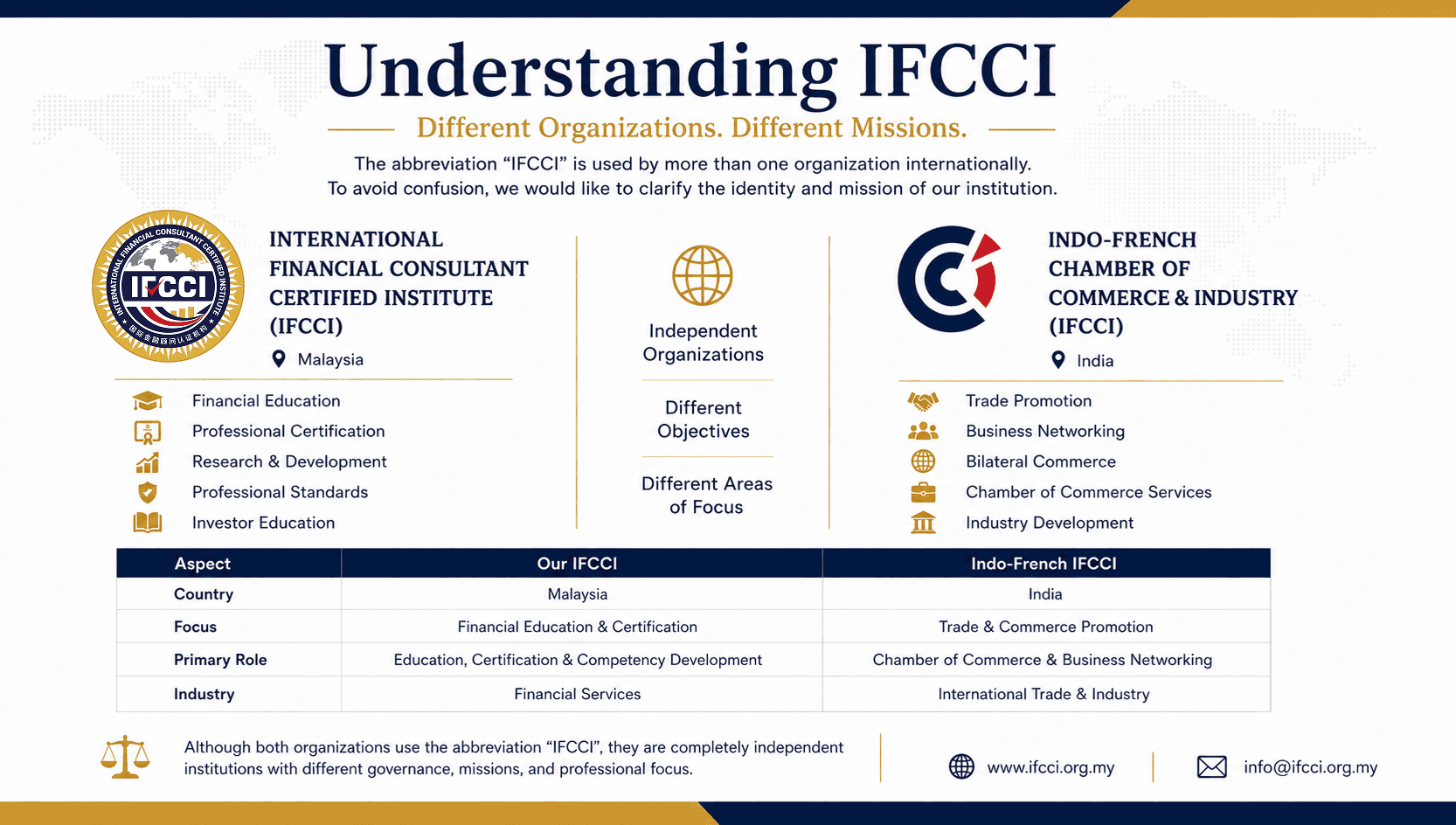
Understanding IFCCI: International Financial Consultant Certified Institute and Other Organizations Using the IFCCI Acronym
27 Jul 2026
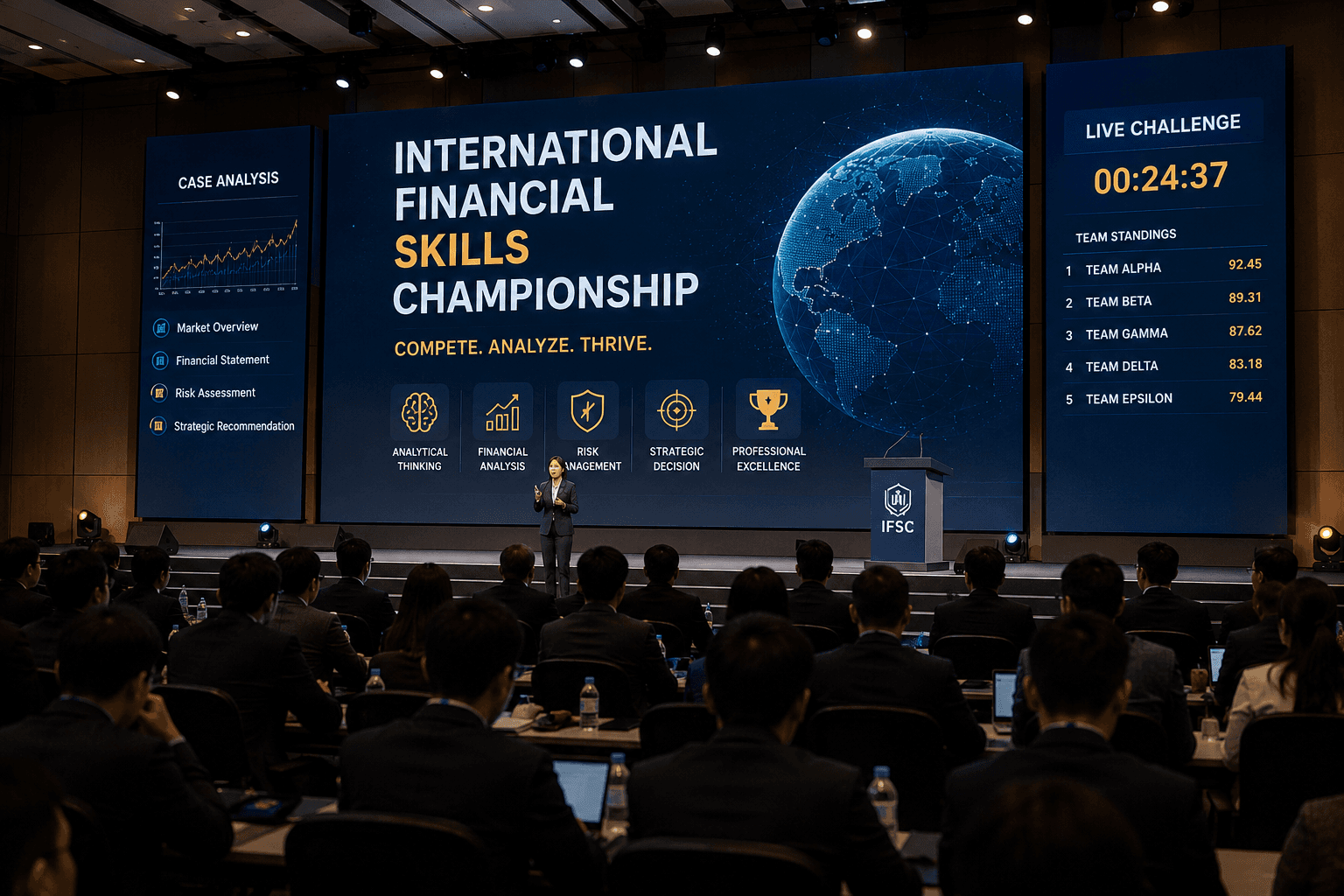
Why International Financial Skills Championships Matter in Developing Global Financial Excellence
13 Jul 2026

How Asia's Financial E-Sports Championship Is Transforming Competitive Financial Learning
8 Jul 2026